




Choosing Your First Motorcycle for Beginners 2026
Table of Contents
- Why Your First Motorcycle Choice Matters
- Types of Motorcycles for Beginners
- Motorcycle Engine Displacement for Beginners
- How to Choose a Motorcycle Seat Height
- MSF Basic RiderCourse Requirements and Safety Training
- Building Your Beginner Motorcycle Fit Checklist
- Total Cost of Ownership for New Riders
- Testing and Evaluating Your Candidate Motorcycle
- Frequently Asked Questions
Last Updated: October 9, 2026
Why Your First Motorcycle Choice Matters
Choosing your first motorcycle is one of the most important decisions you'll make as a new rider. It affects your confidence, safety, and how long you stay engaged with the sport.
The wrong motorcycle can derail you before you start. Too much power overwhelms inexperienced hands, too much weight exhausts your arms and legs, and a seat that's too high leaves you tiptoeing at stops.
Types of Motorcycles for Beginners
Different motorcycle categories prioritize speed, comfort, handling, or a blend. For beginners, the category you choose shapes your entire riding experience.
Standard and Naked Bikes
Standard and naked bikes are the foundation of beginner motorcycle selection.
The lightweight frame and moderate power make low-speed maneuvers manageable, so you can practice tight U-turns and parking lot drills without fighting the bike's geometry.
Standards excel at building fundamentals: you learn throttle control without the bike punishing sloppy inputs, and develop balance and countersteering without fearing that one mistake will highside you.
Beginner-Friendly Sportbikes
Sportbikes intimidate new riders, and rightfully so: the aggressive position, higher-revving engines, and twitchy throttle demand precision.
These machines reward smooth inputs and punish abrupt ones, teaching discipline faster than any other category.
The tradeoff is higher insurance costs and a steeper throttle-management learning curve, so you'll spend your first months thinking about inputs rather than enjoying the ride.
Cruisers for New Riders
Cruisers place you in a laid-back, feet-forward position that feels instantly comfortable. The low seat height appeals to shorter riders, and the relaxed ergonomics reduce fatigue on longer cruises.
However, cruisers are heavier than comparably-powered standards, so steering demands more deliberate inputs and tight maneuvers require more muscle.
Cruisers also have slower-revving engines optimized for low-RPM torque, which is forgiving with throttle control.
Motorcycle Engine Displacement for Beginners
Engine displacement, measured in cubic centimeters (cc), is the volume of air and fuel the engine draws in per cycle. It's the best proxy for power output and throttle response, and understanding it is essential for choosing your first motorcycle for beginners.

Understanding CC and Power Delivery
A 300cc engine produces roughly one-third the power of a 600cc engine, a gap that feels enormous with inexperienced hands on the throttle.
Throttle response varies wildly even within the same displacement class. Some engines deliver power linearly across the RPM range; others have a low-RPM dead zone and then hit hard.
Entry-Level Engine Sizes: 300cc to 500cc
The 300cc to 500cc range is where most successful beginner journeys begin.

A 300cc machine moves you with authority but forgives imprecise throttle control, and many riders spend an entire first season on one without feeling underpowered.
The 400cc to 500cc range splits the difference: more punch for highway riding and faster group rides, still manageable after a few months of practice.
Why 600cc and Above Demand Experience
A 600cc engine produces roughly double the power of a 300cc, and delivery at the top of the RPM range is even more aggressive.
Riders with fewer than 2,000 miles of experience consistently overestimate their ability to handle 600cc and larger machines.
The insurance industry reflects this: a 600cc bike costs significantly more to insure for a new rider than a 300cc, even from the same brand and year, because underwriters have decades of data showing new riders on 600cc+ bikes file more claims.
How to Choose a Motorcycle Seat Height
Seat height is the most concrete factor determining whether you can plant both feet flat at a stop, and the most misunderstood. Many new riders assume touching the ground with their toes means the bike fits. That's a recipe for low-speed crashes.
Measuring Your Inseam and Reach
Your inseam is the distance from your crotch to the floor standing barefoot with feet hip-width apart, and it directly correlates to the seat height you need.
With both feet flat on the ground, your knees should have a slight bend of roughly 15 to 20 degrees.
Reach, the distance from seat to handlebars, matters equally.
Many manufacturers publish reach and seat height specs, but don't rely solely on those numbers.
The Confidence Factor: Feet Flat on the Ground
Flat feet at a stop are about confidence, not safety.
If you're between two bikes and one lets you touch flat while the other has you on tiptoes, choose the flat-footed one. The confidence gain is worth the slight power or feature tradeoff.
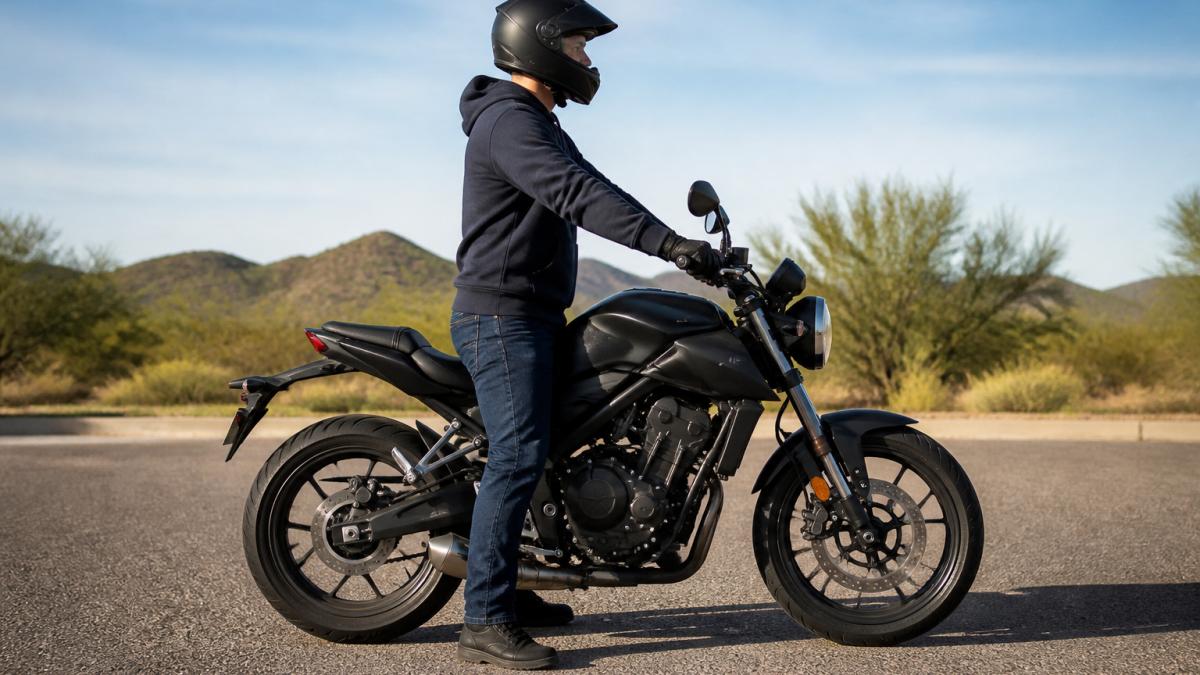
MSF Basic RiderCourse Requirements and Safety Training
Before you buy your first motorcycle, get formal training.
The MSF course is 15 to 20 hours of classroom and range instruction across two or three days.
GT50 Electric Dirt Bike, 48V 28MPH Off-Road Ride →
Many states offer insurance discounts for completing the MSF course, and some waive the riding test portion of the license exam.
Don't skip this step.
Building Your Beginner Motorcycle Fit Checklist
Choosing your first motorcycle for beginners requires evaluating multiple dimensions at once. A single-factor decision leads to regret, so use this checklist to assess candidates systematically.
Rider Height, Strength, and Intended Use
Start with your body: stand barefoot and have someone measure your inseam, then cross-reference it against the manufacturer's specified seat height.
Next, assess upper body strength. If you're smaller-framed, a lightweight standard beats a heavier cruiser regardless of seat height.
Consider intended use. Commuting 10 miles daily on city streets suits a lightweight, nimble standard. Weekend highway group rides call for more power and comfort.
| Factor | Beginner-Friendly Range | Red Flag |
|---|---|---|
| Seat Height | 2-4 inches below your inseam | More than 4 inches below or requiring tiptoes |
| Engine Displacement | 300cc-500cc | 600cc+ for first bike |
| Dry Weight | Under 400 lbs | Over 450 lbs for riders under 5'8" |
| Riding Position | Upright to slightly forward | Aggressive sport position |
| Throttle Response | Smooth, linear power delivery | Abrupt power band or lag |
Weight and Low-Speed Handling
Dry weight, the bike's weight without fuel or fluids, directly impacts low-speed control.
Test-ride candidates and focus on slow-speed feel. Can you control it with one hand while checking mirrors, hold it upright at a stop without your legs burning out, and execute a tight U-turn without putting a foot down?
Low-speed handling is where most new rider crashes happen. Prioritize it above top-end power or premium features.
Total Cost of Ownership for New Riders
The purchase price is only the beginning. Insurance, gear, maintenance, and fuel add up quickly. Understanding total cost of ownership prevents sticker shock and helps you budget realistically.
Insurance, Gear, and Maintenance Expenses
Insurance for a new rider on a 300cc standard varies with age, location, and riding history, with younger and urban riders paying more.
Protective gear is non-negotiable. A quality helmet, jacket, gloves, and boots cost between $400 and $800 for entry-level options.
Routine maintenance, oil changes, chain cleaning, tire rotations, costs $100 to $200 per year for a beginner who rides moderately.
Many new riders underestimate fuel costs.
Testing and Evaluating Your Candidate Motorcycle
Before you buy, test-ride every serious candidate. A test ride reveals what spec sheets and photos never will.
What to Look for During a Test Ride
Start in a parking lot. Practice figure-eights, U-turns, and emergency stops. Does the bike feel stable? Does the throttle respond smoothly?
Move to city streets.
If possible, ride for at least 30 minutes.
Pay attention to your mental state. If you're anxious and overthinking every input rather than enjoying the ride, the bike isn't the right fit.
Used Versus New: Inspection Guidance
A used motorcycle costs less upfront but carries unknown history. A new machine costs more but comes with a warranty and the certainty that nothing's been abused.
Many first-time buyers benefit from buying new.
Powersportsmegastore.com offers fully built motorcycles ready to ride, ensuring proper setup from day one.
Choosing your first motorcycle for beginners is one of the most rewarding decisions you'll make.
Frequently Asked Questions
What is the best motorcycle for a beginner in 2026?
The best first motorcycle matches your height, strength, and riding goals. Entry-level models with 300cc to 500cc engines, lightweight frames, and predictable power delivery suit most new riders. Standard and naked bikes offer upright seating and excellent control. Test-ride several models to find one where you can place both feet flat on the ground at stops and comfortably reach the handlebars. Consider electric options like the GT50, which eliminate gear shifting and offer quiet, manageable power for learning.
What size motorcycle should a beginner start with?
Start with 300cc to 500cc motorcycles. These engines deliver enough power for highway riding and confident acceleration without overwhelming a new rider's throttle control. Avoid 600cc and larger engines; they demand precise throttle management and higher-speed confidence. Lightweight bikes under 350 lbs make low-speed maneuvers easier and build confidence faster. Your height and inseam determine seat height, aim for models where both feet touch the ground when seated.
How does the MSF Basic RiderCourse prepare you for your first bike?
The Motorcycle Safety Foundation (MSF) Basic RiderCourse teaches foundational skills on a controlled range before you ride in traffic. You learn throttle control, braking, turning, and emergency maneuvers on a small training bike. The course covers helmet selection, protective gear, and how to inspect your motorcycle. Most states waive the riding portion of the motorcycle endorsement exam if you complete the MSF course, and many insurance companies offer discounts to riders who finish it. Completing the course before buying your first motorcycle builds real-world confidence.
How do you determine the right seat height for your build?
Measure your inseam while wearing the boots you'll ride in, then compare it to the motorcycle's seat height. You want both feet flat on the ground when seated. If your inseam is under 28 inches, look for bikes with seat heights under 31 inches. If your inseam is 30+ inches, standard-height seats (31-33 inches) work well. Test-sit on the actual model before buying. Stock seats are the safest starting point for beginners.
Is a 600cc engine too powerful for a first-time rider?
Yes, 600cc engines demand more throttle precision and speed management than beginners typically possess. A 600cc bike accelerates harder and reaches higher speeds faster, leaving less margin for control mistakes. New riders benefit from smaller, more forgiving engines where mistakes don't escalate as quickly. Stick with 300cc to 500cc for your first year, then upgrade once you've logged real-world miles and understand your riding style and limits.
What are the main types of motorcycles for beginners?
Standard and naked bikes offer upright seating, good visibility, and balanced weight distribution, ideal for new riders. Beginner-friendly sportbikes provide sporty styling with manageable power and lower seat heights. Cruisers feature low seats, relaxed riding positions, and heavier frames that demand more strength at low speeds but reward smooth throttle control. Electric dirt bikes like the RM7 and GT50 eliminate gear shifting entirely and deliver instant, smooth power. Choose based on your intended use: commuting, trail riding, or casual cruising.
What should I check when test-riding a motorcycle?
Before starting, confirm both feet touch the ground when seated and you can reach the handlebars comfortably. Check that the throttle feels responsive but not jerky, and that brakes engage smoothly without grabbing. Accelerate gently to feel power delivery, it should be predictable, not sudden. Practice low-speed maneuvers in a parking lot to test handling and balance. Listen for unusual engine sounds and check that controls (clutch, shifter, brakes) respond intuitively. Ride for at least 15 minutes to assess comfort and fatigue.


