




How to Measure ATV Bolt Patterns: A Step-by-Step Guide
Table of Contents
- What ATV Bolt Patterns Are and Why They Matter
- Tools You Need to Measure Bolt Patterns Accurately
- How to Measure a 4-Lug Bolt Pattern
- How to Measure a 5-Lug Bolt Pattern
- ATV Wheel Offset Explained
- ATV Wheel Center Bore Measurement
- Common ATV and UTV Bolt Patterns You'll Encounter
- Matching Wheels to Your ATV: Front and Rear Considerations
- Frequently Asked Questions
Last Updated: October 11, 2026
What ATV Bolt Patterns Are and Why They Matter
Understanding how to measure ATV bolt patterns is essential before purchasing new wheels. A bolt pattern describes how the lug holes are arranged on your wheel hub. Getting this measurement right ensures your wheels fit properly and your ATV performs safely.
The bolt pattern determines compatibility. If your measurement is even slightly off, wheels won't mount correctly, causing vibration, misalignment, or safety issues. Accurate measurement prevents costly mistakes.
Understanding Lug Holes and Bolt Circle Diameter
Your wheel hub has a specific number of lug holes arranged in a circle. The bolt circle diameter is the measurement across that circle from the center of one lug hole to the center of the opposite hole (or the calculated circle if holes don't sit directly opposite).
For four-lug hubs, measure from the center of one hole to the center of the hole directly across. For five-lug patterns, measure between adjacent holes, then apply a calculation to find the true circle diameter.
The bolt circle is always measured in inches or millimeters. Common ATV patterns use inches. This measurement, combined with the number of lugs, creates your complete bolt pattern specification.
Even Versus Odd-Numbered Lug Patterns
Even-numbered patterns (3-lug, 4-lug, 6-lug) have holes directly opposite each other. This makes measurement straightforward. You measure directly across from one hole to another.
Odd-numbered patterns (5-lug) have no holes in direct opposition. Measuring a 5-lug pattern requires a different approach. You measure between specific holes, then apply a mathematical formula to find the true bolt circle diameter.
Most ATVs use either 4-lug or 5-lug patterns. Understanding which type you have changes your measurement method. This distinction matters because the formulas differ, and using the wrong one gives you an incorrect result.
Tools You Need to Measure Bolt Patterns Accurately
You don't need expensive equipment, but choosing the right tool helps you measure ATV bolt patterns accurately and prevents errors that lead to incorrect wheel purchases.
Metal measuring tape or rigid ruler. Use a metal tape measure or steel ruler that reads in both inches and millimeters. Avoid fabric tapes; they stretch and introduce errors of 0.1 to 0.25 inches.
Digital or dial calipers (recommended). Calipers measure with precision to 0.01 inches or 0.5 millimeters and are useful for verifying lug hole diameter and center-to-center distances on 5-lug patterns. A measuring tape works without them, but calipers reduce measurement uncertainty.
Understanding measurement units and rounding. ATV bolt patterns are specified in inches or millimeters. A 4x110 pattern means 4 lug holes and a bolt circle diameter of 110 millimeters (approximately 4.33 inches). Measurement tolerance of ±0.05 inches is normal and acceptable.
Pen and paper. Record your measurements immediately: lug count, bolt circle diameter (in inches or millimeters), center bore diameter, offset, and position (front or rear). A simple note prevents confusion when shopping.
Wheel removed from the ATV. Remove the wheel completely for clear, unobstructed access to the hub and lug holes.
Clean hub surface. Wipe dirt and debris from the hub so you can see the lug hole centers clearly and position your measuring tool accurately.
Measurement checklist:
- Metal tape or ruler (not fabric)
- Calipers (optional but recommended)
- Pen and paper
- Wheel removed
- Hub cleaned
- Both front and rear wheels (measure both separately)
How to Measure a 4-Lug Bolt Pattern
Four-lug patterns are the most common on smaller ATVs. The measurement process is straightforward because the holes sit directly opposite each other.
Step-by-Step Measurement Process
Step 1: Identify the four lug holes. Locate the four evenly spaced holes on your wheel hub where lug nuts attach.
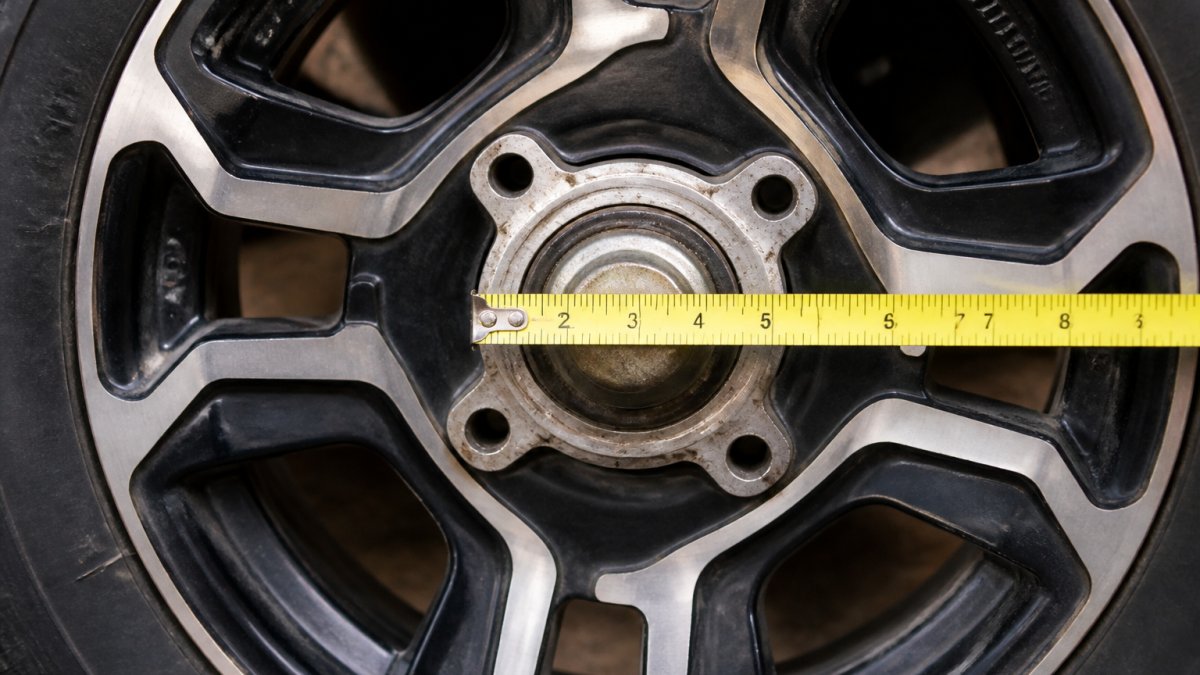
Step 2: Position your measuring tape. Place one end of the tape at the center of one lug hole. Run it straight across to the center of the hole directly opposite. This is your bolt circle diameter.
Step 3: Read the measurement. Common 4-lug patterns are 4x110 and 4x156, where the first number is lug count and the second is bolt circle diameter in millimeters.
Step 4: Double-check your measurement. Measure a second time using the other two holes. Measurements should match exactly; if they differ, you measured at an angle.
Step 5: Record the pattern. Write down "4-lug" and your bolt circle diameter. Note whether your measurement is in inches or millimeters. This information is critical for ordering new wheels.
Verifying Your Measurement
Verify your measurement matches known patterns: 4x110 (Yamaha, Kawasaki), 4x115 (some Polaris), or 4x156 (larger ATVs). If it doesn't match, remeasure to ensure the tape was centered on lug hole centers. Compare to your ATV's manual to confirm.
How to Measure a 5-Lug Bolt Pattern
Five-lug patterns appear on larger ATVs and UTVs. Because the holes don't sit opposite each other, the measurement method differs from 4-lug patterns.
Measuring Center-to-Center Distance
Step 1: Locate the five lug holes. Five holes are arranged in a circle with equal spacing.
Adult Gas ATV, 177cc, Automatic with Reverse, 40+ MPH →
Step 2: Find the measurement points. Identify two adjacent lug holes and measure from the center of one to the center of the next.
Step 3: Position your measuring tape. Place the tape at the center of one lug hole. Run it to the center of the hole immediately beside it. This is your center-to-center distance.
Step 4: Measure carefully. Keep the tape straight and centered on both holes; even a slight angle throws off the measurement.
Step 5: Apply the conversion formula. For 5-lug patterns, the bolt circle diameter is calculated, not measured directly. Multiply your center-to-center measurement by 1.701 to get the bolt circle diameter.
Example: A center-to-center distance of 3.15 inches × 1.701 = 5.36 inches (approximately 137 millimeters).
Confirming Five-Lug Patterns
Common 5-lug ATV and UTV patterns include:
- 5x110 (Polaris Ranger and some UTVs)
- 5x127 (larger UTVs and utility machines)
- 5x139.7 (some specialty builds)
Compare your calculated bolt circle diameter to known sizes. If it matches, your pattern is confirmed. If not, remeasure and recalculate.
ATV Wheel Offset Explained
Offset is a separate measurement from bolt pattern, but it's equally important for proper wheel fit. Offset describes where the wheel's mounting surface sits relative to the hub centerline.
Offset is measured in millimeters, typically -20 to +50mm on ATVs. Negative offset pushes the wheel outward; positive pulls it inward. Incorrect offset affects handling, clearance, and suspension geometry, and can cause rubbing or interference.
Your ATV manual lists the correct offset for your machine. Stick to that specification. Choosing wheels with different offset creates fitment problems even if the bolt pattern is correct.
ATV Wheel Center Bore Measurement
The center bore is the opening at the back of the wheel that slides over the hub's center. This measurement must be precise.
Your wheel's center bore must match or be slightly larger than your hub's center bore. Measure with calipers or tape; common ATV sizes range from 50mm to 85mm. Oversized center bores are acceptable and allow the wheel to center correctly. A center bore smaller than your hub won't work.
Common ATV and UTV Bolt Patterns You'll Encounter
Knowing standard patterns helps you verify your measurement and shop confidently.
Yamaha ATVs typically use 4x110. Kawasaki ATVs often use 4x110 or 4x115. Honda ATVs commonly use 4x110. Polaris ATVs frequently use 4x156 or 5x110; Ranger UTVs often use 5x110 or 5x127. Arctic Cat and Textron machines vary by model. Always reference your manual; smaller youth ATVs may use 3-lug patterns.
Matching Wheels to Your ATV: Front and Rear Considerations
Your ATV may have different bolt patterns on the front and rear hubs. Always measure and verify both positions before purchasing wheels, and use a systematic approach to confirm your results.
Measure front and rear separately. Remove and measure the front wheel, then the rear wheel. Most ATVs have identical patterns, but some larger utility models use different sizes front and rear. If measurements don't match, you need separate wheels for each position.
Record offset and center bore for each position. Offset and center bore may also differ between front and rear. Check your ATV's manual for the complete specification for each position:
- Front bolt pattern (e.g., 4x110)
- Front offset (e.g., +10mm)
- Front center bore (e.g., 56mm)
- Rear bolt pattern (e.g., 4x110)
- Rear offset (e.g., +15mm)
- Rear center bore (e.g., 56mm)
Write these down in a single document or note. This becomes your reference when shopping.
Verification workflow for uncertain measurements. If your measurement doesn't match a known pattern:
- Remeasure with a different tool. If both tools give similar results within ±0.05 inches, your measurement is likely correct.
- Compare to your ATV's manual. The manual lists the exact bolt pattern, offset, and center bore, the definitive source.
- Check existing wheel markings. Wheels are often stamped with bolt pattern, offset, and center bore (e.g., "4x110 +10 56.1").
- Cross-reference a fitment chart. Search for a fitment chart specific to your ATV's make, model, and year.
- Remeasure if inconsistent. Ensure you're measuring from lug hole centers, not edges. For 5-lug patterns, verify you applied the 1.701 multiplier correctly.
Common measurement mistakes to avoid:
- Measuring from the edge of a lug hole instead of the center (adds 0.1 to 0.2 inches of error)
- Measuring at an angle instead of straight across (causes inconsistent results)
- Forgetting to apply the 1.701 formula for 5-lug patterns (results in a meaningless number)
- Confusing inches and millimeters (110mm is not the same as 110 inches)
- Measuring only one position and assuming both front and rear are identical (some ATVs differ)
Record your findings in a simple table:
| Position | Lug Count | Bolt Circle Diameter | Offset | Center Bore | Source (Manual / Measurement / Wheel Marking) |
|---|---|---|---|---|---|
| Front | 4 | 110mm (4.33") | +10mm | 56mm | Manual |
| Rear | 4 | 110mm (4.33") | +15mm | 56mm | Manual |
Once you've verified both positions and recorded all specifications, you have a complete fitment profile. Use this when shopping to ensure any wheel you purchase matches these exact measurements.
Frequently Asked Questions
How do you know the bolt pattern of a wheel?
Measure the distance between the centers of opposite lug holes for even-numbered patterns, or use the three-point method for five-lug wheels. You can also check your ATV's owner manual, contact the manufacturer, or use an online database with your specific model and year. Accurate measurement ensures safe fitment.
What tools do you need to measure an ATV bolt pattern?
A measuring tape or ruler, calipers for precise readings, and a straightedge or ruler for alignment work best. For five-lug patterns, you may need a protractor or angle finder. Clean the wheel hub first to ensure accurate measurements. Most home toolkits have what you need to get started.
What does 4x110 mean on an ATV wheel?
The first number (4) indicates four lug holes; the second number (110) is the bolt circle diameter in millimeters, measured center-to-center between opposite lugs. This notation tells you exactly which wheels will fit your hub. Common ATV patterns include 4x110, 4x156, and 5x112.
Can you put different bolt pattern wheels on an ATV?
No. Wheels must match your ATV's bolt pattern exactly to mount safely. Mismatched patterns prevent proper wheel seating, cause vibration, and create safety hazards. Always verify your machine's pattern before purchasing wheels. Proper fitment is essential for trail performance and rider safety.


